
FAQs : GDP Inspection
1) What is Good Distribution Practice (GDP)?
The measures to be taken during storage, transportation, and distribution of registered products / notified cosmetics and their related materials to ensure the quality and integrity of the intended use are preserved when they reach consumers.
2) Why is GDP a necessity?
GDP can serve as a guide for parties involved in the supply chain of registered products / notified cosmetics to maintain the quality and integrity of registered products/notified cosmetics at all levels of the supply chain.
All holders of Manufacturer’s License / Import License / Wholesaler’s License are required to fulfil:
1. The license condition is to comply with GDP requirements.
2. The directive from the Senior Director of Pharmaceutical Services to manufacturers / importers / wholesalers of registered products / notified cosmetics has been in effect since 1 January 2012 to comply with GDP requirements as stipulated in the Guidelines on Good Distribution Practice, Malaysia.
3) What are the guidelines regarding GDP that can be referred to?
1. Guideline on Good Distribution Practice
2. Supplementary Notes on Annex 1: Management of Time and Temperature Sensitive Products (TTSP) of Guideline on Good Distribution Practice
4) What is a GDP inspection?
Inspection of the Import License and the Wholesaler’s License holders to verify compliance with the Guideline on Good Distribution Practice.
5) Who will be subject to the GDP inspection?
Import License and Wholesaler’s License holders.
6) Who will perform the GDP inspection?
The officers from NPRA and/or the Pharmacy Enforcement Division.
7) What types of GDP inspections will be conducted?

8) Which mode of inspection will be used?
The NPRA will determine the mode of inspection based on a risk assessment that has been conducted.
GDP inspection will be conducted either (a) on-site or (b) remotely:
a) On-Site Inspection
A physical inspection conducted at the business premises and/or store address(es) of registered products / notified cosmetics.
b) Remote Inspection
A virtual inspection involving the evaluation of documentation and a live virtual tour of the premise(s) and/or store(s) via an agreed-upon online communication platform.
9) What will be checked during the GDP inspection?
The inspection scope will encompass compliance aspects based on the Guideline on Good Distribution Practice. A general review of the inspection scope can be found in Annex 2: General Points to Consider for Auditee.
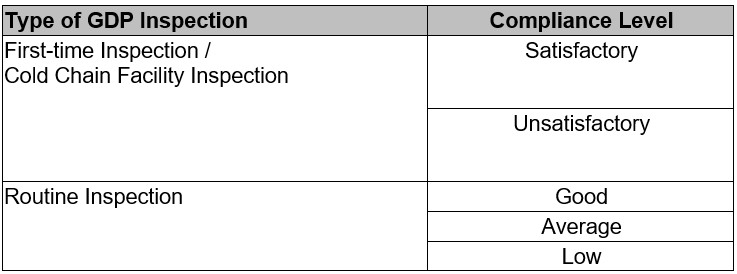
10) What are the categories of GDP compliance levels?
Based on the findings of the inspection, the following levels of GDP compliance will be determined:
11) How long does a GDP inspection take?
The duration of time taken for each GDP inspection depends on the scope and activities related to GDP under the responsibility of the holder of the Import License and the Wholesaler’s License.
12) Is the GDP inspection conducted only once or periodically?
The GDP inspection will be conducted periodically, and the determination of the inspection frequency is based on a risk matrix established by NPRA covering the current level of GDP compliance, the scope of GDP activities, and the types of products handled.
13) What happens if our company does not comply with the GDP requirements?
Regulatory punitive actions can be imposed on companies that fail to comply with GDP requirements.
14) Does our company need a GDP inspection before applying for a new Import License / Wholesaler’s License?
License application for year 2024 and earlier
Not necessary. The company can proceed to apply for an Import License / Wholesaler's License, and NPRA will schedule the GDP inspection at the company's premises later.
License application for year 2025 and later
Under the enhanced licensing process, a GDP inspection may be required following submission of a new Import License / Wholesaler’s License application, subject to predefined criteria. Applicants must be fully prepared for documentation review and an inspection as part of the evaluation process.
15) The Cold Chain Facility Inspection has been conducted by the NPRA. What are the next steps?
The following steps depend on the outcome of the inspection:
If the outcome is Pending CAPA:
The company must submit a satisfactory Corrective and Preventive Action (CAPA) report to NPRA within six (6) months from the inspection date. Failure to submit satisfactory CAPA report within this period will result in the inspection being deemed Unsatisfactory.
If the outcome is Satisfactory (or Satisfactory after CAPA):
The company may apply for updating the License Conditions for handling cold chain products to the Licensing and Certification Section, Centre of Regulatory Coordination and Strategic Planning, NPRA. Please refer to the Surat Makluman Penambahbaikan Proses Pengeluaran Lesen Mengimport / Lesen Pemborong Melalui Penilaian dan Pemeriksaaan Pra-Pelesenan, effective from 27 March 2024.
Cold Chain Facility Inspection details for the company can also be found on the Cold Chain Facilities List.
If the outcome is Unsatisfactory (or Unsatisfactory after CAPA):
The company may reapply for the Cold Chain Facility Inspection six (6) months after the previous inspection date, subject to consideration of the CAPA implemented.
This period allows the company to have sufficient time to implement comprehensive CAPA to address all identified deficiencies. Effective CAPA resolution is crucial to ensure the company is fully prepared to handle cold chain products, thereby safeguarding the product’s quality, safety and efficacy.
16) Our company holds an Import License / Wholesaler’s License and is involved solely in distribution activities using documentation (no storage, transportation, or direct distribution of registered products / notified cosmetics). Is our company subject to GDP inspection?
Yes.
The GDP inspection also applies to third parties appointed by the company to handle the storage, transportation and/or distribution of its registered products / notified cosmetics.
17) Does NPRA issue any certification for compliance with GDP requirements?
No.
18) As a holder of an Import License / Wholesaler’s License, is our company allowed to perform packaging activities in the business premises and/or store(s)?
The company may refer to Appendix 32: Explanatory Notes for Repackers of the Drug Registration Guidance Document (DRGD) and/or contact the Good Distribution Practice Section, Centre of Compliance and Quality Control, NPRA.
19) What are the common compliance issues identified by GDP Inspectors during GDP inspections on importers and wholesalers of registered products / notified cosmetics?
The NPRA generates reports highlighting common deficiencies found during GDP inspections. These reports assist stakeholders in identifying and addressing compliance issues to improve their practices.
20) Why is Remote Inspection implemented?
Remote Inspection offers flexibility while maintaining the effectiveness of the inspection process, even in challenging circumstances. This method has been successfully used by NPRA during the COVID-19 pandemic, and will now be implemented as an alternative to on-site inspections.
Its implementation also aligns with the enhanced licensing process, which introduced pre-licensing evaluation and inspection.
21) What do companies / license holders need to prepare for a Remote Inspection?
Companies / license holders must:
• Provide consent to participate in the Remote Inspection.
• Submit required documents similar to those reviewed during On-Site Inspections.
• Ensure access to stable internet and virtual communication tools.
• Prepare their premises for a virtual tour.
For any further questions regarding GDP, the company may contact NPRA through the following channels:
Phone: +603-78835400 or Staff Directory
Official Email: saeb@npra.gov.my
Official Portal: https://npra.gov.my
Updated 19 December 2024
1) WHO SHOULD APPLY?
As defined under the Control of Drugs and Cosmetics Regulations 1984, Regulation 12(1):
- Manufacturer’s Licence / Lesen Pengilang
Manufacturers are required to apply for a Manufacturer’s Licence in order to manufacture registered products in their premises and to sell by wholesale or supply the registered products.
- Import Licence / Lesen Mengimport
Importers are required to apply for an Import Licence in order to import and sell by wholesale or supply registered products from their premises.
- Wholesaler’s Licence / Lesen Pemborong
Wholesalers are required to apply for a Wholesaler’s Licence in order to sell by wholesale or supply registered products from their premises.
2) WHAT IS A REGISTERED PRODUCT?
A registered product is a drug that is approved by the Drug Control Authority (DCA) for sale/use in Malaysia. This drug has been evaluated and tested for its efficacy and safety. Every registered product is given a registration number, which must be printed on its label or package. All product registration numbers start with ‘MAL’, for example MAL12345678A.
3) WHY SHOULD YOU APPLY FOR A LICENCE?
As defined under the Control of Drugs and Cosmetics Regulations 1984, Regulation 7(1):
- ….., no person shall manufacture, sell, supply, import, possess or administer any product unless -
(a) the product is a registered product; and
(b) the person holds the appropriate licence required and issued under these Regulations.
6) CAN A LICENCE APPLICATION BE REFUSED?
As defined under the Control of Drugs and Cosmetics Regulations 1984, Regulation 14:
The Director of Pharmaceutical Services may, if he thinks fit and without assigning any reason, refuse any application for a licence.
9) CAN THE STORES BE IN A DIFFERENT STATE THAN THE BUSINESS/MANUFACTURING PREMISE?
No. All the stores must be in the same state as the business/ manufacturing premise. Exception is only for Selangor and Wilayah Persekutuan Kuala Lumpur. For example, if the business/ manufacturing premise is located in Selangor while the store is in Wilayah Persekutuan Kuala Lumpur, it is permissible.
10) HOW MUCH IS THE PROCESSING FEE?
As defined under the Control of Drugs and Cosmetics Regulations 1984, Regulation 13:
- The processing fee of an application for a Manufacturer’s Licence is RM1000.00 and RM500.00 for an Import Licence or a Wholesaler’s Licence.
- The processing fee shall not be refundable.
- Online banking account (Personal or Business) or credit card is required to conduct payment transactions via FPX (Financial Process Exchange).
11) HOW LONG IS THE LICENCE VALID FOR?
Manufacturer’s Licence/ Import Licence/ Wholesaler’s Licence is valid for one (1) year starting from 1 January to 31 December of the same year.